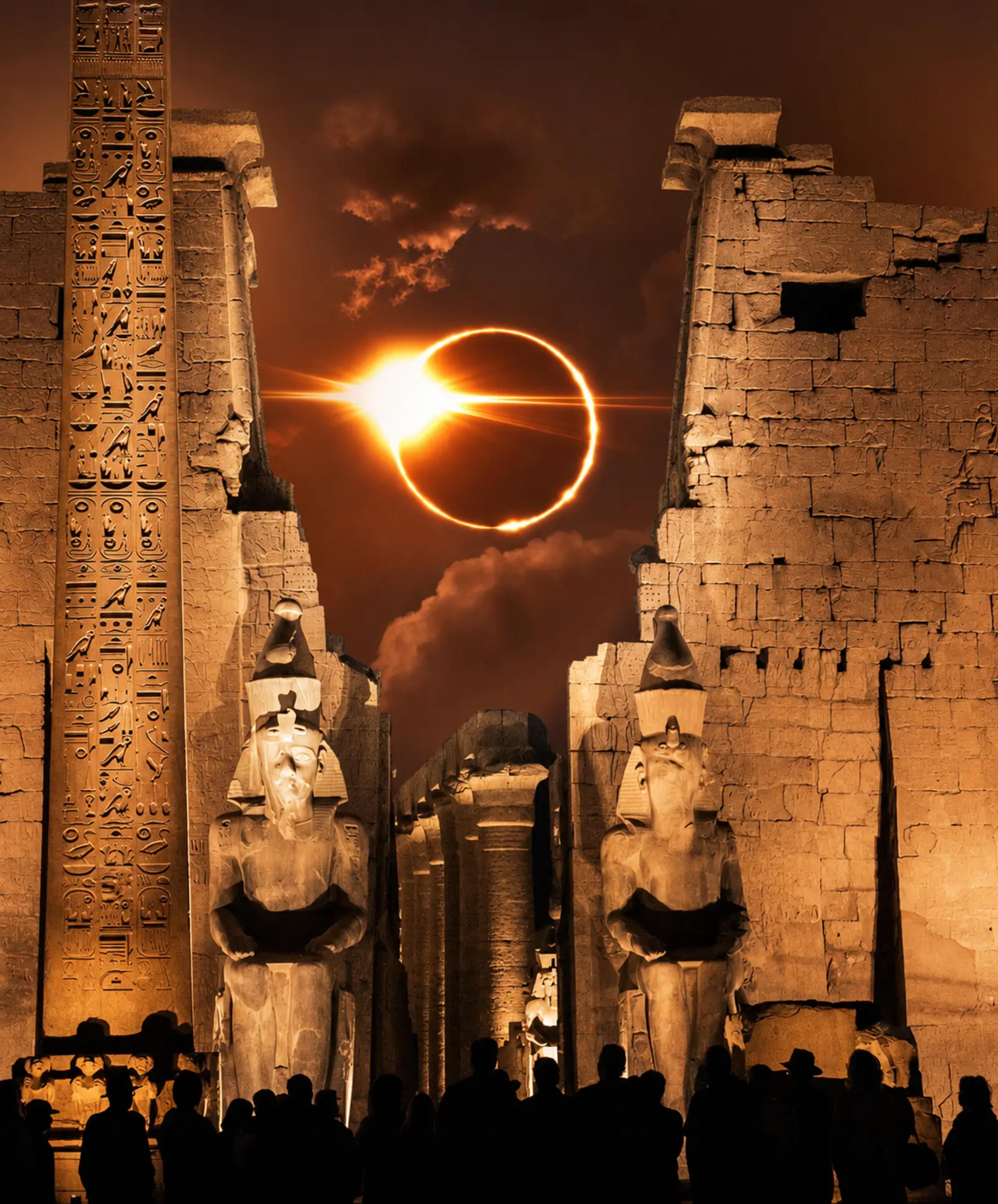
Luxor rewards the photographer who knows where to be and when. I have been planning this itinerary around the light since 2009.
Luxor's light changes completely in the first and last hours of the day — golden and blue hours in a desert climate are more extreme than elsewhere
Most sites face east or north — this affects when the light enters where
The photographer's clock: roughly as detailed in /journal/luxor-photographers-clock.md
05:30: blue hour at east bank (Karnak entrance, Avenue of Sphinxes still in shadow)
06:00–07:30: first golden hour — Hypostyle Hall column raking light, Sacred Lake reflections
Midday: avoid outdoor sites unless intentional (harsh overhead shadows can work abstractly)
15:30–17:00: West Bank softening — Hatshepsut terraces and Valley of the Kings approach road
17:00–18:30: second golden hour — Colossi of Memnon from the road; West Bank cliffs turn amber
18:30–19:00: blue hour over the Nile
I adapt the route to the season — summer changes the light times significantly
"The Hypostyle Hall at 06:15 has ten minutes where the light comes in at exactly the right angle. After that the angle changes and the drama is gone for another day. I've been watching that window for seventeen years."
What you'll see
Karnak Hypostyle Hall: light shafts through stone column gaps at 06:00–07:00 — the defining Luxor interior shot
Sacred Lake reflections: Hypostyle pylon mirrored in still water at dawn
Karnak sphinxes: the human-headed sphinxes along the new Avenue connection in morning shadow and light contrast
Hatshepsut terraces: three-level colonnaded terraces creating long horizontal shadow lines in afternoon sun
Colossi of Memnon: golden-hour faces in warm direct light; sky transition to deep blue behind
Nile at blue hour: both dawn and dusk — reflections, felucca silhouettes, east-bank skyline
Included / Not included
Included: Private licensed guide (Youssef) with photography light knowledge, private vehicle with driver
, Karnak entry, Luxor Temple entry, Hatshepsut entry, Colossi of Memnon (free), water throughout Not included: Gratuities, lunch, tripod permits (these vary by site and must be arranged in advance —
), Valley of the Kings entry (add-on option)
Difficulty & comfort
Long day with two distinct active periods (dawn and late afternoon), with a genuine midday rest. Total walking is approximately 5–7 km. The pre-dawn start and post-dusk finish mean temperature swings — early morning in winter is cold; late afternoon in summer is still very hot. I recommend layering for all seasons. Camera equipment should include a UV filter for desert dust conditions. Tripod use in some areas requires advance notice.
Common questions
Q: Do I need a professional camera for this tour? A: No — I have done this with guests using mirrorless cameras, DSLRs, and phones. The light I am taking you to works for any camera. That said, for the Hypostyle Hall in particular, a camera that performs well in low-to-medium light will produce better results.
Q: Is a tripod permitted at Karnak? A: Tripod regulations at Karnak and other Ministry of Tourism sites require a separate permit and are applied inconsistently. I will advise you on current rules when we book and help arrange permits where possible.
Q: Can we focus the whole day on just Karnak? A: Yes. Karnak alone in the first two hours and last two hours of light is a full photographic day. I can arrange a single-site Karnak photographer's session as a custom option.
Q: Can this be combined with a West Bank dawn (Valley of the Kings at first light)? A: Yes — I can arrange a Valley of the Kings dawn option as part of a two-day itinerary that splits the two banks by light priority. Contact me to discuss.
Q: What if the light is overcast or flat? A: Overcast light is actually excellent for tomb interiors — eliminates harsh reflections in the relief carvings. For exterior sites a flat day is less dramatic but I adjust the shooting positions accordingly. Luxor has very few genuinely overcast days in any season.
Light, line, and the right hours
Photography in Luxor is a timing problem. The sites themselves are always extraordinary; the question is whether the light is doing what you need it to do when you are standing in front of them. In the summer months, the harsh midday sun flattens the relief carvings at Karnak and bleaches the colour from the painted tombs. In winter, the low sun rakes across the stone surfaces in the first and last hours of the day in a way that makes the bas-relief legible in three dimensions — the carver's mark becomes visible in raking light in a way that full sun overhead erases. A photographer's day is structured entirely around those two windows: the first two hours after sunrise and the last two hours before sunset.
I have been working with photographers — professional and serious amateur — in Luxor since the early years of my guiding practice. What I learned quickly is that the needs of a photographer and the needs of a standard tourist are almost opposite: the tourist wants to move through as many sites as possible; the photographer wants to stay in one place until the light changes. I no longer treat photography days as a version of the standard itinerary with a camera. They are a different kind of day entirely, built around the sites that reward extended attention and designed to avoid the crowds that make photography in public spaces difficult.
East Bank in the morning: Karnak at six
The Hypostyle Hall at Karnak at six in the morning is the most consistently productive photography location in Luxor. The columns — one hundred and thirty-four of them, the tallest at twenty-one metres — create a corridor geometry that is only visible as light when the sun is low enough to enter at an angle. By eight, the direct light is above the column capitals and the interior becomes evenly lit; the geometry disappears. By nine, the tour groups have arrived and the foreground is occupied. The one-hour window between six and seven, before the bus circuit begins and while the sun is still horizontal, is the window I plan every photography day around.
The Sacred Lake at dawn holds a still reflection of the Hypostyle Hall's south face that is reliable in low-wind conditions between October and April. The scarab statue at the lake's edge catches the first direct light of the morning — the stone is polished black granite and the light wraps around it in a way that makes it legible from distance. The obelisks of Hatshepsut, at the centre of the complex, catch the electrum tip first: that is where Hatshepsut intended the dawn light to fall, and she was correct. At six-fifteen in winter the tip glows before the obelisk shaft is fully in light. It is a brief effect but a reliable one.
West Bank in the late afternoon: tombs and terraces
The Valley of the Kings is not ideal for photography — flash is prohibited, tripods are often restricted, and the tomb interiors are dimly lit. What the valley offers is the exterior landscape: the approach road framed by the limestone cliff walls, the entrance to individual tombs photographed from across the valley floor, the view back from the hill above the workers' village at the valley's eastern end. The landscape of the valley has a quality that is difficult to capture and correspondingly difficult to forget — the bare limestone, the total absence of vegetation, the sense of a landscape entirely given over to one purpose.
Hatshepsut's mortuary temple at Deir el-Bahri is the most architecturally composed photography subject on the West Bank. The three terraces step back against the cliff face, and the cliff face itself — two hundred metres of pale limestone — provides a background that no photographer could design. The colonnades are in shade until mid-morning; in winter, the low sun enters from the south and rakes across the column faces at a sharp angle that makes the carved reliefs pop. The Punt expedition reliefs, in the south colonnade, catch this light for approximately forty minutes in the late morning in winter conditions. That is when I take photographers there.
Practical considerations
Professional equipment (tripods, dedicated camera bags, multiple bodies) requires coordination with the site authorities in advance. I handle this when I know what a guest is bringing. For photographers using mirrorless cameras and standard lenses, no advance coordination is needed for most sites — bring a small bag that you can carry on your back and keep a low profile at the ticket control. The sites are public and photography is permitted; heavy equipment is what draws official attention.
The ideal photography-day structure has two sessions: East Bank in the early morning (6:00–10:00), a rest in the middle of the day during peak sun, and West Bank in the late afternoon (15:00–18:00). This produces six to seven hours of actual photography time against a ten-hour day, and both sessions are in useful light. It is a tiring schedule — worth it if you have come specifically to photograph. I carry a battery bank for charging between sessions and a printed site map with the locations I consider most productive at each time of day.
Hour by hour
Pre-dawn departure; cold water; brief light briefing for the day
Photo cue: —
Blue hour; west bank cliffs reflected in still Nile; feluccas at rest
Photo cue: Wide: Nile panorama at blue hour, felucca silhouettes
Hypostyle Hall in first golden light; Sacred Lake reflection if still conditions
Photo cue: Column light shafts; lake reflection; sphinx avenue at dawn
Obelisk tips in direct early sun; outer pylon texture from low angle
Photo cue: Low-angle full obelisk; pylon stone texture close-up
Review images; plan afternoon light positions
Photo cue: —
Deliberate harsh-light abstract visit — ram sphinx lineup; deep shadow geometry
Photo cue: Abstract: column capital shadows; hard shadow geometry
Midday rest avoids the worst light;
Photo cue: —
Nile crossing in afternoon light; feluccas moving; west bank approach
Photo cue: Nile from ferry deck; west bank cliffs ahead
Approach road photographed at 15:00 — cliffs beginning to catch directional light
Photo cue: Road receding toward cliff base; afternoon shadows
Terraces in afternoon light — shadow lines defining the colonnade columns
Photo cue: Wide terrace with long column shadows; detail of Punt frieze
Second golden hour — faces of the colossi in direct western light; amber/gold palette
Photo cue: Wide: two colossi against deep blue sky; golden face detail
Nile again from ferry in blue hour; eastern light dying over Karnak
Photo cue: Blue hour from Nile water; Karnak silhouette on east bank
—
Photo cue: —