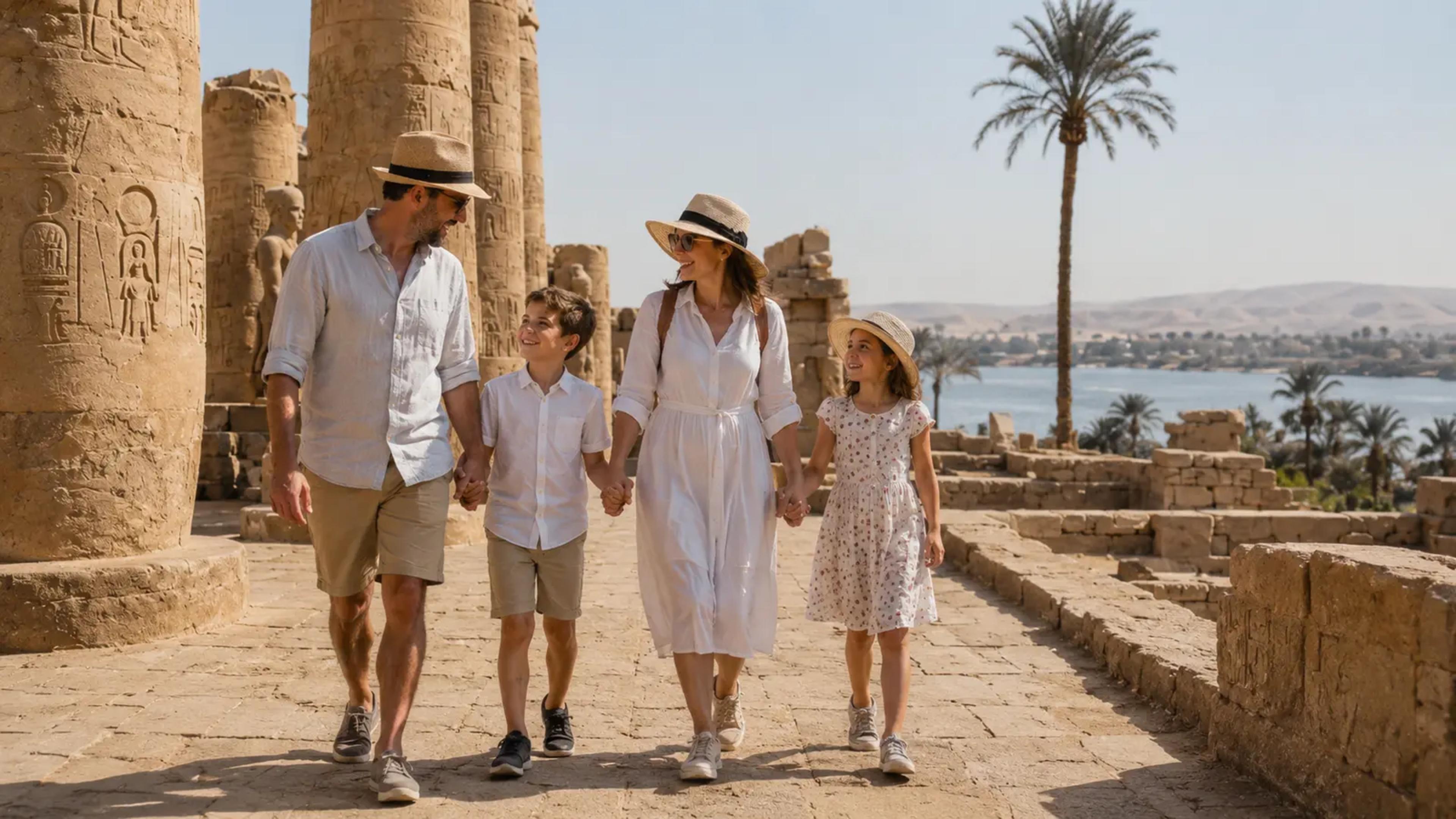
I adapt to the age and energy of every family. The goal is that everyone — from the eight-year-old to the grandparent — leaves with something they will talk about for years.
Family Day is structured shorter than a standard full-day, with more rest time. Total active touring: 4–5 hours. Total outing: 7–8 hours including pickup, lunch, and drop-off.
Most family visits to Egyptian sites become endurance tests — too much walking, too much heat, too many things the children cannot engage with
This day is built around children aged 6–14 and their parents/grandparents experiencing the same sites in a way that everyone finds meaningful
Karnak is ideal for families: it is large enough to be visually overwhelming (which is the point) and has specific story-hooks that work well for children (the Hypostyle Hall scale, the hieroglyphic naming game, the sacred animals)
Luxor Temple as an afternoon option — shorter, more contained
Colossi of Memnon — visually striking, no entry fee, accessible, excellent for scale conversation with children
"With children I find that the cartouche name game changes everything. Once they can spot 'Ramses' on a wall they start reading the whole temple."
Heat and pace are managed explicitly — morning outdoor sites, midday break, optional afternoon only if energy permits
What you'll see
Karnak's Hypostyle Hall — 134 columns; I use scale comparisons children can relate to (height of a school building, width of a football pitch)
The Sacred Lake — the sacred crocodiles are gone, but the story of the morning ritual is compelling for children
Hieroglyphic cartouches — royal name-reading exercise with children; finding the same name repeated on different walls
Colossi of Memnon — the sheer scale comparison of human against 18-metre stone figures; the most accessible single image for families
Luxor Temple (optional afternoon) — the Avenue of Sphinxes as a connecting story between the two temples
Included / Not included
Included: Private licensed guide (Youssef), private vehicle with driver
, Karnak entry for all family members, Colossi of Memnon (free), water throughout Not included: Gratuities, lunch, Luxor Temple entry (if included in afternoon), any optional extras
Difficulty & comfort
This tour is designed to be easy in terms of physical demand. I build in rest stops, keep the walking pace relaxed, and shorten the route if any family member needs it. The morning outdoor section at Karnak is between 07:30 and 10:00 — manageable even in summer for most families if water is kept up. For grandparents with mobility concerns, I can pre-plan routes that avoid the roughest stonework and stay on the main paved corridors at Karnak. The Colossi of Memnon require no entry and involve minimal walking. In summer, I recommend the optional afternoon Luxor Temple only if the family is genuinely comfortable in the heat.
Common questions
Q: What age is this tour suitable for? A: Children from approximately age 6 upward. For younger children (3–5) the sites can be engaging but the walking and heat management becomes the main variable — I recommend discussing in advance. The tour works best for mixed-age groups where even the grandparents' pace is factored in from the start.
Q: My parent uses a walking stick. Is Karnak accessible? A: Karnak's main corridors are wide and the principal areas are manageable with a cane. The ground is uneven stone in places — I will plan the route around the smoother paths. The extreme outer courts and conservation areas are more challenging; we do not need them for a family visit.
Q: Will you explain things in a way children will understand? A: Yes — I adjust my entire approach based on who is listening. With children I use comparisons, stories, and games. I will not lecture; I will involve them. That said, I do not dumb down what is genuinely interesting — in my experience children respond better to being treated as curious people than to simplified cartoons.
Q: Can we do this in Arabic for the children? A:
Q: Is a stroller practical at Karnak? A: For infants in a stroller, Karnak's main processional paths are navigable but some sections have steps and high thresholds. A carrier or front pack is more practical than a wheeled stroller at most Egyptian sites. I can advise further based on the specific ages and equipment you are bringing.
Designing for grandparents and grandchildren together
The Family Day grew out of conversations with travellers who were trying to solve a specific problem: how do you bring a ten-year-old and a seventy-year-old to the same ancient site and have both of them leave satisfied? The standard tour answers this question badly. The lecture mode that works for adult learners bores children quickly; the child-focused approach that uses games and simplified stories condescends to grandparents who have been reading about Egypt for forty years. I have been solving this problem on a case-by-case basis for years, and I have found that the solution is not a compromise between the two but a mode that works for both simultaneously.
Children engage with ancient Egypt through the same things that serious adults engage with: scale, specificity, and story. The Hypostyle Hall at Karnak works for a ten-year-old because one hundred and thirty-four columns are visibly extraordinary, and the carved reliefs at eye height — painted figures of pharaohs and gods — are immediately legible as images even without the hieroglyphic context. What I change for a family is not the content but the delivery: shorter segments, more movement, more questions addressed to the children rather than answered at them, and an honest response when I am asked something I cannot answer confidently.
Sites that work for mixed ages
Karnak in the morning is the best choice for a family day. The processional way of ram-headed sphinxes is immediately impressive to children — each ram cradles a small figure of the pharaoh between its front paws, which is a detail that children always notice and adults often miss. The Sacred Lake gives a moment of visual relief from the density of the temple complex; the circumambulation of the scarab statue is easy to explain and participatory in a way that children appreciate. The Hypostyle Hall itself is navigable at a child's pace without rushing — the aisles between the columns are wide, and children can touch the column bases freely in most sections.
On the West Bank, Hatshepsut's mortuary temple works for families better than the Valley of the Kings. The three terraces are visually spectacular — the cliff face backdrop is immediately legible as dramatic even to a young child — and the walk up the ramp from the approach road is active without being strenuous. The tomb interiors in the Valley of the Kings involve descending steep ramps in the dark with crowds, which is stressful for older guests with mobility concerns and frightening for some young children. If a family includes grandparents with limited mobility or a child under eight, I keep the Valley of the Kings as an optional extra rather than a central element.
Pacing and comfort
The Family Day runs shorter than the standard full-day tours — six to seven hours rather than eight to nine — with a longer lunch break in the middle of the day. I build in more stop-and-look moments and fewer walk-and-talk segments. Water is constant; sun protection is essential year-round and critical from May through September. I carry a small kit of sunscreen and hand wipes for the sites where touching is possible, and I check with parents before the day about any dietary restrictions for lunch.
The accommodation question matters for families. I know which Luxor hotels have pools that children can use in the midday rest, and I take that into account when planning the day's structure — if the family is staying somewhere with a pool, the middle-of-day break can be at the hotel rather than at a restaurant, which gives children space to decompress between the morning and afternoon sessions. That combination — intensive engagement in the morning, genuine rest at midday, shorter afternoon session — is what I have found produces a family day that everyone remembers as worthwhile.
The questions children ask at ancient sites are often the most interesting questions of the day. Why did the pharaoh need that many rooms? How did they make the paint stay on the wall? Were the workers paid? I answer these with as much honesty as I can: sometimes the answer is that we know, sometimes that we are guessing, and sometimes that nobody knows and we are still arguing. Children respect honesty about the limits of knowledge in a way that makes the ancient world feel genuinely alive rather than a set of facts to be received.
Hour by hour
Relaxed start (not pre-dawn); brief family introduction and plan
Photo cue: —
First Pylon introduction; Hypostyle Hall (scale conversation); Sacred Lake
Photo cue: Child at base of column for scale; family group shot
Cartouche name game at a clear wall section; find Ramses, Thutmose, Hatshepsut
Photo cue: Child's hand pointing at carved name; eye-level shot
Shaded rest; cold water; regroup for energy check
Photo cue: —
Short drive west bank (optional); massive statues at child eye level; scale story
Photo cue: Wide: family at base of colossus; adult+child for scale
Decision point based on family energy levels
Photo cue: —
Photo cue: —
If energy allows — shorter site; Avenue of Sphinxes easy walk; good for photos
Photo cue: Family group under sphinx
—
Photo cue: —