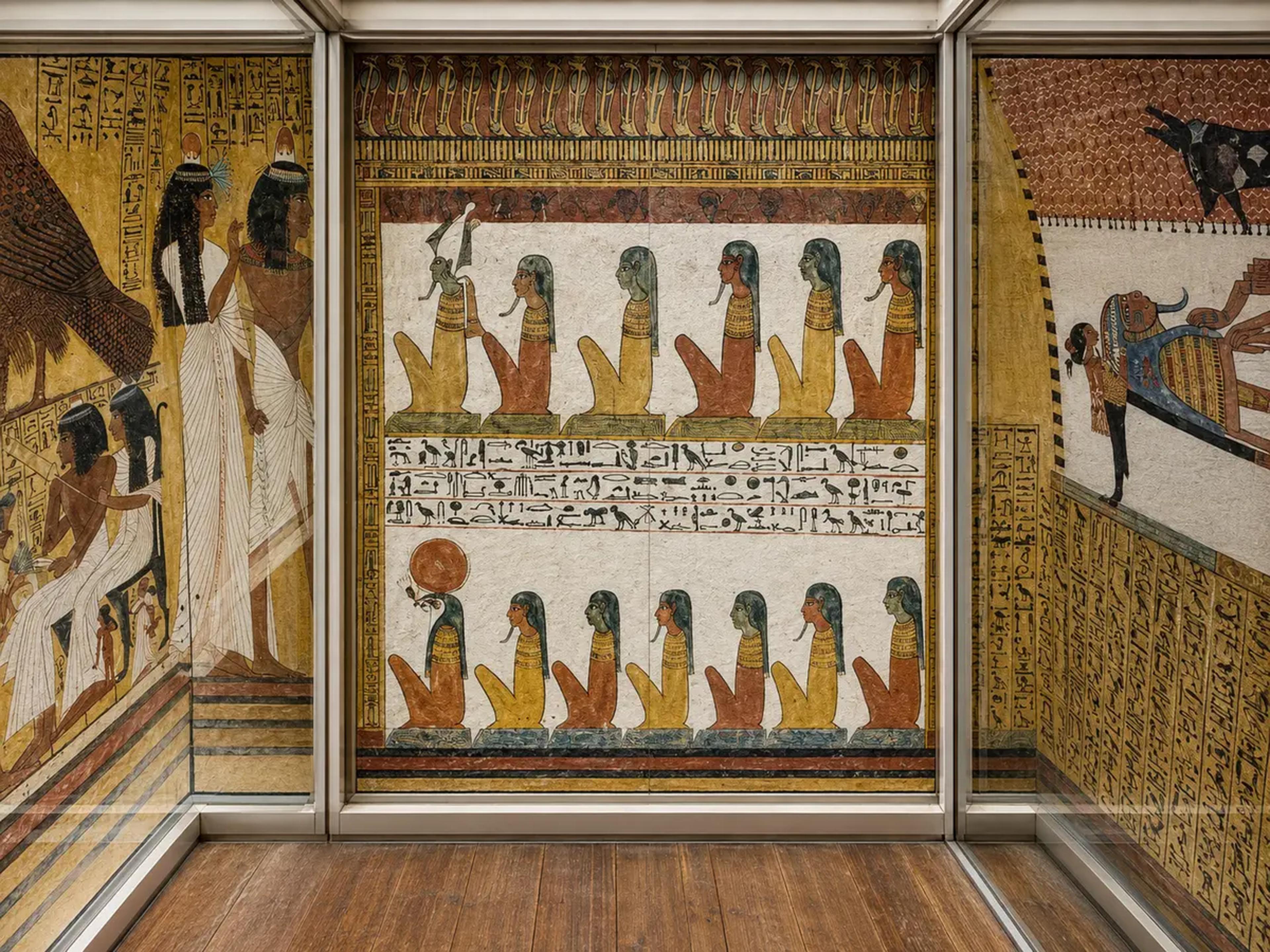
The Tombs of the Nobles is a phrase that covers several distinct cemetery areas in the limestone hills of the West Bank — Sheikh Abd el-Qurna, Khokha, Deir el-Medina, Dra Abu el-Naga, and others. The collective entry in the standard tourist itinerary vastly underrepresents what these tombs contain. The royal tombs of the Valley of the Kings are the famous ones; the Nobles' tombs are where you see how ancient Egypt actually looked.
Why They Matter
Royal tombs show you the theological world of ancient Egypt — the journey through the underworld, the weighing of the heart, the reception of the pharaoh by the divine. The tombs of the officials, the nobles, the craftsmen's supervisors, the scribes, the army commanders show you the living world. Banquets with musicians and dancers. Fishing and fowling in the papyrus marshes. The weighing of grain. Cattle being herded across a ford. Men painting a wall. These are scenes from actual life in ancient Egypt, observed and recorded by artists who lived that life.
The Tomb of Rekhmire (TT100), for example, shows in extraordinary detail the workshops of Thebes under Thutmose III — metalworkers, woodworkers, leather craftsmen, potters — with the goods being presented to Rekhmire himself as vizier. The Tomb of Nakht (TT52) contains some of the finest surviving paintings of banquet scenes, including the famous 'Blind Harpist' scene. The Tomb of Sennefer (TT96), known as the Tomb of the Vineyard because of its ceiling covered with painted grape arbors, is one of the most visually striking interiors in the Theban necropolis.
What to Look For
In the Nobles' tombs, look at the ceilings. Royal tomb ceilings are typically astronomical — star ceilings, maps of the sky, divine barques. Noble tomb ceilings are often geometric patterns, textile designs, or in the case of Sennefer, naturalistic vegetation. This shift in subject matter reflects a difference in theological status: the pharaoh navigated the celestial realm; the official lived in and celebrated the terrestrial one.
Look also at the transition between registers. The Nobles' tomb paintings are organised in horizontal bands (registers) that read from left to right and from bottom to top. Understanding the register system — what is happening simultaneously across the width of the wall, versus what is sequential — unlocks the paintings. A farmer harvesting grain in the lower register and the grain being presented to the tomb owner in the upper register is not two separate scenes; it is one continuous narrative read in sequence.
Look at the hieroglyphic texts. In royal tombs, the texts are primarily religious — excerpts from the Book of the Dead, the Amduat, the Book of Gates. In Nobles' tombs, the texts often include biographical statements: 'I was one who loved justice and hated wrongdoing,' 'I gave bread to the hungry and clothing to the naked,' formulaic phrases that were meant to ensure the tomb owner's acceptance by the divine judges. These are not abstract claims. They are the ancient equivalent of a professional resume.
Access and Ticketing
The Tombs of the Nobles are divided into separate ticket zones. The Sheikh Abd el-Qurna group (which includes Rekhmire, Sennefer, and several others) requires one ticket. The Khokha group (which includes Nakht and others) requires a separate ticket. Special tickets are required for some of the most significant tombs individually. This ticketing structure is confusing for first-time visitors and sometimes changes without advance notice; confirm with the ticket office at the entrance to the West Bank on the day of your visit.
Access hours are typically 6 a.m. to 5 p.m. (check current hours as seasonal adjustments apply). The tombs are small — most have a single or double chamber — and can only accommodate a few visitors at a time. Do not visit during the peak midday window (10 a.m. to 2 p.m.) in summer. The tombs are unventilated and the air inside can become very stuffy when they are crowded.
Practical Notes
The Nobles' tombs are accessible as part of any West Bank day tour. I typically include two to three tombs depending on the interests of my clients: one primarily for the biographical scenes and daily-life paintings (usually Rekhmire or Nakht), one for the ceiling interest (Sennefer), and one that provides contrast with the royal tomb programme (often one of the smaller, less-visited tombs that are never crowded). The combination gives a more complete picture of the West Bank than any single visit to the Valley of the Kings alone.
Walking distance from the ticket office to the main cluster of Sheikh Abd el-Qurna tombs is approximately 10 to 15 minutes on a partly uphill path. Flat shoes with grip are preferable to sandals. The path is unpaved and can be loose underfoot in places.