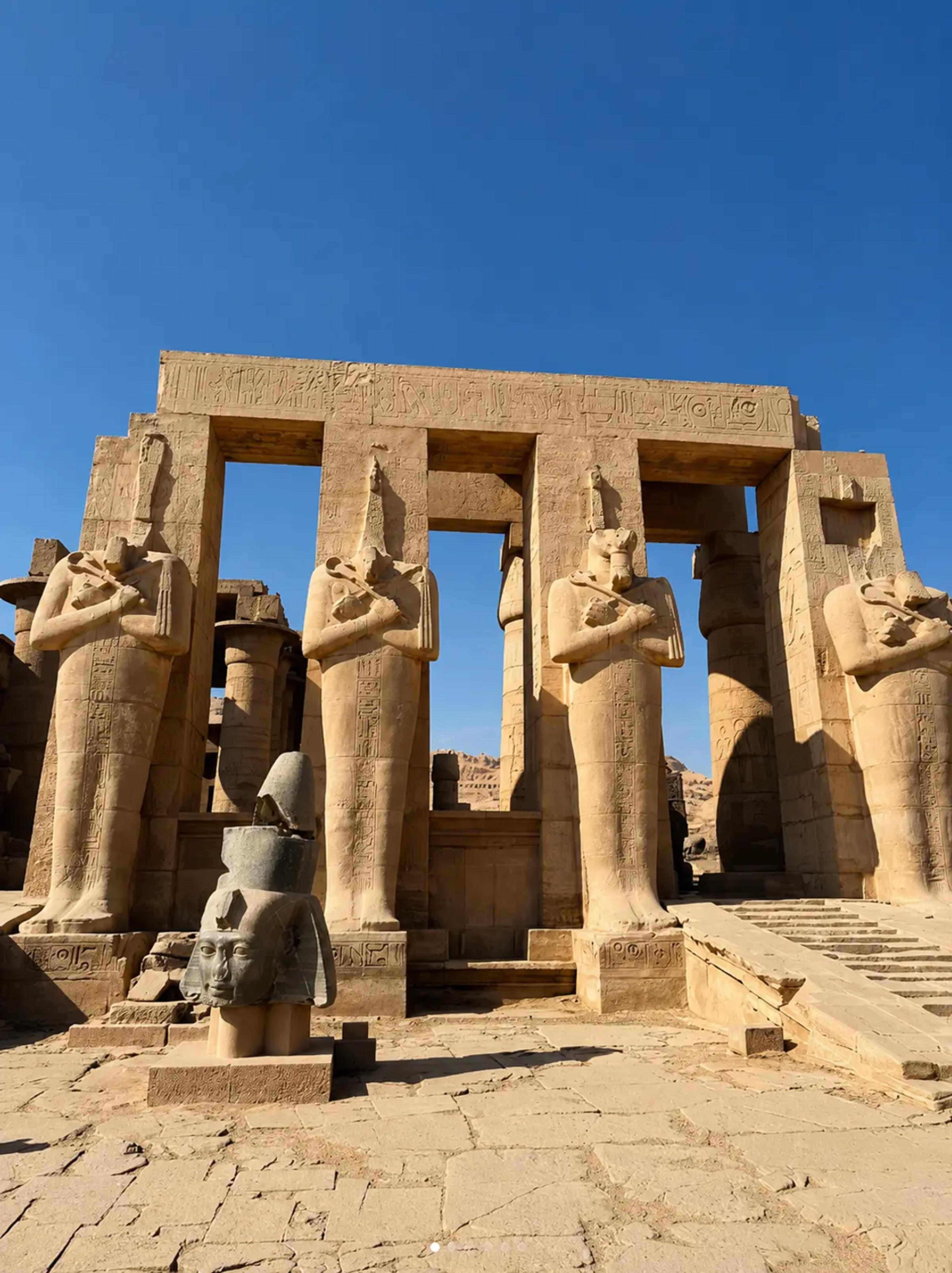
The Ramesseum is the memorial temple of Ramesses II, built on the West Bank of Luxor and largely constructed between approximately 1280 and 1213 BCE. It is not the most intact temple in Luxor — Medinet Habu, the memorial temple of Ramesses III nearby, is better preserved — but it contains some of the most significant reliefs on the West Bank and it is, on most mornings, almost empty of visitors. I bring clients here specifically because of that quiet.
What It Is
A memorial temple (also called a mortuary temple) served a different function from a cult temple. It was built to sustain the royal cult after the pharaoh's death — to ensure the eternal provision of offerings, the maintenance of the pharaoh's divine status, and the continuity of his connection to the gods. The Ramesseum was not Ramesses II's tomb (that is KV7 in the Valley of the Kings) but the administrative and ritual centre of his posthumous cult on the West Bank.
The temple was once much larger. Today the first pylon is collapsed — the Nile floods over centuries undermined its mudbrick foundations — and the outer courts are fragmentary. The inner sanctuary and the hypostyle hall survive in reasonably good condition. The granaries and storerooms behind the temple, built in mudbrick and largely destroyed, give the complex a uniquely archaeological quality — you are walking through the ruins of a functioning economy, not just a ritual space.
The Battle of Kadesh
The most significant decorative programme in the Ramesseum is the long narrative relief of the Battle of Kadesh, which runs across the exterior of the first pylon and continues inside. The battle, fought around 1274 BCE against the Hittite empire in what is now Syria, was a strategic near-disaster for Egypt that Ramesses II propagandised as a spectacular personal victory. The reliefs show the Egyptian army, the Hittite chariot charge, the pharaoh fighting alone against the Hittite forces, and his personal recovery of the situation.
The Battle of Kadesh reliefs are historically significant beyond their artistic quality: the Egyptian-Hittite peace treaty that followed the battle is one of the earliest known diplomatic agreements in human history, and a copy of it is displayed at the United Nations in New York. Reading the reliefs at the Ramesseum alongside the peace treaty changes how you understand the scale and complexity of the ancient Near Eastern political world that Egypt operated within.
The Fallen Colossus
In the first court of the Ramesseum lies the shattered upper portion of what was once an enormous seated statue of Ramesses II — estimated at approximately seventeen to eighteen metres tall, making it one of the largest single-piece granite sculptures ever attempted in ancient Egypt. The statue fell, probably in an earthquake or as a result of the structural failure of the pylon against which it leaned, and the fragments lie where they landed. Percy Bysshe Shelley was inspired by a description of this statue — provided by the traveller Diodorus Siculus and relayed to him by the scholar Horace Smith — to write Ozymandias in 1818. 'Look on my works, ye Mighty, and despair.'
The actual head of the colossus is in the British Museum in London (it was removed in 1821 by Giovanni Belzoni). The torso, fragments of the feet, and scattered sections of the throne remain at the Ramesseum. The cartouche on the throne — the name of Ramesses II — is still readable. Standing next to the fragments, it is possible to judge the original scale of the figure and to understand what it means to attempt a seventeen-metre stone portrait of a single individual.
Practical Visiting Notes
The Ramesseum requires a separate ticket from the Valley of the Kings and is often included in West Bank combination tickets — confirm at the ticket office. Access hours are typically 6 a.m. to 5 p.m. The site is partially excavated and partially in active conservation; some sections may be closed on any given day. The walking surface is uneven in the outer courts.
I recommend the Ramesseum in the late afternoon, when the site is nearly empty and the low sun illuminates the relief carvings at an angle that makes them fully readable. The hypostyle hall in late afternoon has a quality of suspended time — the columns rising into shadow above you, the carved surfaces catching the western light — that is worth seeking out. Tours that include this site: the West Bank Day and Two-Day Luxor itineraries both pass through the Ramesseum; the Specialist Day tour can be configured to spend longer here for visitors with specific interest in the Battle of Kadesh reliefs.