What it is
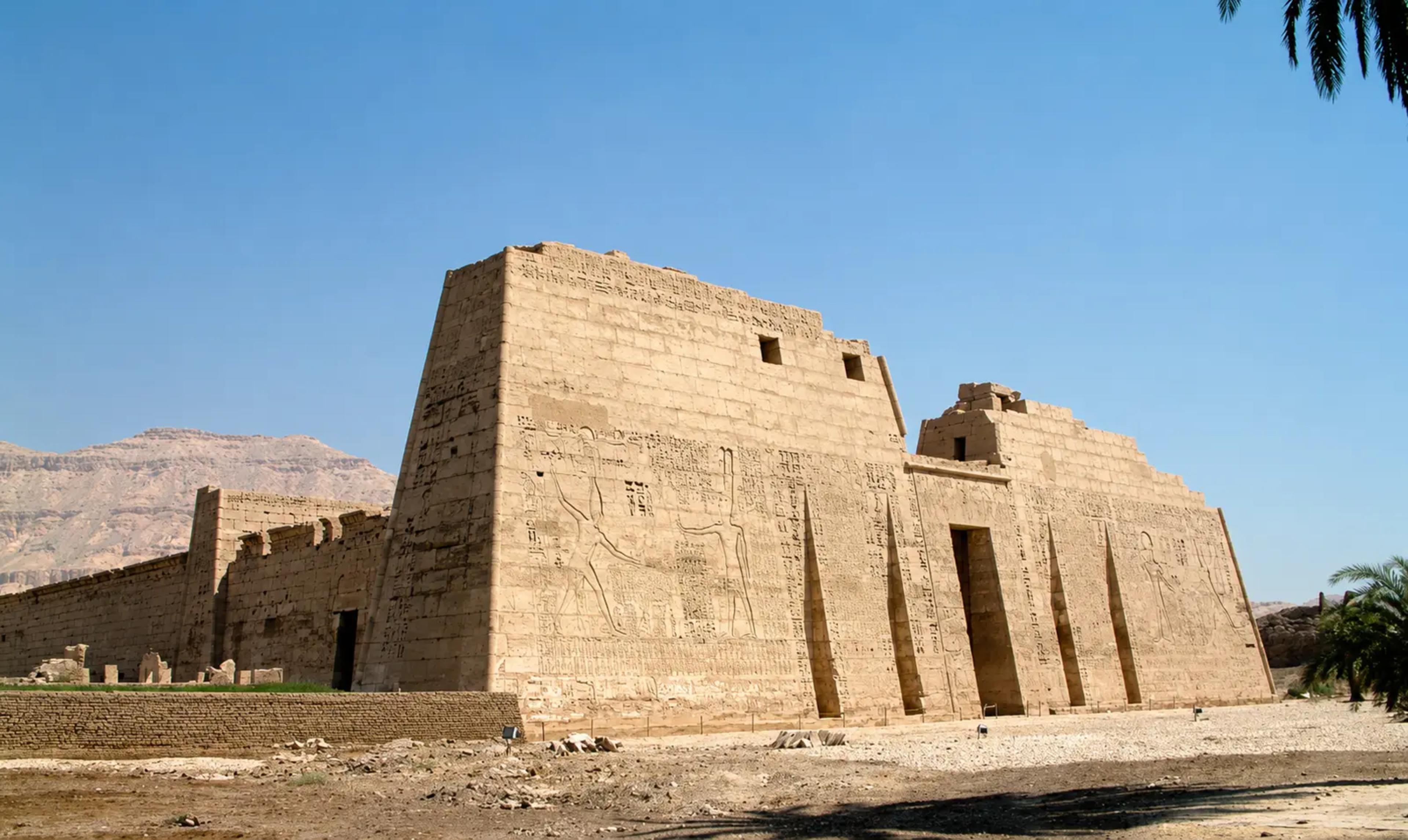
Medinet Habu (Arabic — "town of Habu"; ancient Egyptian Djamet) is the mortuary temple complex of Ramses III on the west bank of the Nile at Luxor, built during the 20th Dynasty (c. 1186–1155 BC). The main temple is one of the best-preserved large mortuary temples in Egypt — better preserved in many sections than Karnak — and covers approximately 7,000 square metres of decorated wall surfaces. The complex includes the main temple of Ramses III, a smaller temple of Amun begun by Hatshepsut and Thutmose III (predating Ramses III by over 250 years), and the remains of a fortified city wall with a migdol (Syrian-style gatehouse). Medinet Habu was the administrative and religious centre of the west bank during the late New Kingdom and the Third Intermediate Period, and remained in continuous occupation into the Coptic era.
Why it matters historically
The Battle of the Sea Peoples — the First Pylon and outer walls of the temple carry the most extensive surviving account of the Sea Peoples invasions, a series of migrations and attacks on Egypt's borders during the reign of Ramses III in Years 8 and 11 of his reign; the reliefs show land and naval battles with extraordinary specificity — ship rigging, armour types, chariot formations, captive bindings; this is the primary visual source for the Sea Peoples, whose identity remains debated in scholarship
The Harem Conspiracy — legal papyri survive recording a conspiracy by members of Ramses III's harem to assassinate the pharaoh and replace him with a lesser son; the conspiracy partially succeeded; the Turin Judicial Papyrus details the trial and punishment of conspirators; the harem rooms whose archaeology connects to these documents are within the Medinet Habu complex; this is one of the most complete records of a political assassination attempt in ancient Egyptian history
The calendar reliefs — the inner rooms of the temple include an exceptionally detailed festival calendar carved into the walls; this is one of the most complete ancient Egyptian ritual calendars surviving; it records the timing of offerings, the identities of the officiants, and the processions scheduled across the year
The migdol gatehouse — the fortified entrance gate is modelled on Syrian military architecture, specifically the migdol form; the upper rooms of the gate were decorated with scenes of Ramses III relaxing with harem women — the private apartments of the pharaoh rendered in relief; this combination of military form and domestic content in a single structure is unique in Egypt
Preservation levels — Medinet Habu was buried in Nile silt for long periods, which protected the lower wall surfaces; the painted colours in the inner rooms, particularly in the Amun chapel, include original green, red, and yellow pigment surviving in circumstances that would have bleached them at an exposed site; the relief quality on the outer walls, combined with the colour survival in the inner rooms, makes this the best single site on the west bank for intact New Kingdom visual culture
What to look for
First Pylon — Battle of the Sea Peoples — the outer face of the massive entrance pylon carries the land battle scenes on the north half and the naval battle on the south; examine the Sea Peoples warriors' distinctive feathered helmets; look for the Egyptian archers in the boat rigging; the scale of the scene — the pylon is approximately 27 metres tall — requires stepping back to take in the full composition
The naval battle reliefs (outer north wall) — the sea battle scene wraps around the outer north wall; Egyptian and Sea Peoples ships are shown in direct engagement; the Egyptian archers are shown firing from the rigging while Sea Peoples warriors fall into the water; the detail of the rigging, anchors, and ship construction is the most complete naval illustration in ancient Egypt
The royal hunt scene (second court, south wall) — Ramses III shown hunting wild bulls and lion in what is understood as a ritual hunt confirming royal power; the animals are shown in mid-flight and in death; the composition is among the most kinetic in New Kingdom art; the figures of the hunted animals are carved with remarkable naturalism compared to the formal human figures
The Amun chapel interior — the earlier Hatshepsut/Thutmose III temple within the complex; painted surfaces in the inner rooms retain original colour at levels uncommon in the Valley of the Kings; the dark interior and intact ceiling painting create a quality of preservation rarely seen in larger temples
The migdol gatehouse — climb to the first storey of the entrance gate (where permitted); the views from the gatehouse over the west bank plain — the Valley of the Queens visible to the southwest, the Theban mountain range above — contextualise the whole necropolis in one field of view;
The sacred lake and the Coptic town — the remains of the ancient lake and the visible foundations of the Coptic settlement at the south of the complex; the Coptic-era church is identifiable from the changed wall orientations; the stratigraphy of occupation here is visible in the wall heights — earlier temple walls used as foundations for later structures
Practical visiting block
Best time to visit: 06:30–09:00 for the First Pylon light — the pylon face catches morning sun from the east, illuminating the relief surface with raking light that makes the carving readable. The site is almost always quieter than Karnak and the Valley of the Kings; midday visits are workable here because the inner rooms are shaded.
Tickets & fees:
Accessibility: The approach to the main pylon is level. The courtyard floors are stone and sand — uneven but manageable. The inner rooms are on the same level as the courts. The migdol gatehouse has a staircase. Not suitable for guests with significant mobility limitations if upper-gatehouse access is desired; the main temple courts and pylon are accessible.
Walking distance: Entrance to deepest inner room: approximately 300 metres. Full site with outer walls and Amun chapel: 1–2 km.
Restrooms: Available at the site entrance.
Tours that include this site
Specialist Day → /tours/specialist-day — Sea Peoples reliefs in depth; the naval battle wall; calendar reliefs; comparison with the Amun chapel interior; this is the tour for guests who want the full scholarly context
West Bank Day → /tours/west-bank-day — afternoon stop after the Valley of the Kings and Hatshepsut; the site's preservation quality is the reason it anchors the end of the day rather than opening it
Related sites
Valley of the Kings → /luxor/valley-of-the-kings — Ramses III is buried in KV11; his mortuary temple at Medinet Habu and his tomb are the two surviving poles of his commemorative programme; the harem conspiracy connects to both sites
Hatshepsut Temple → /luxor/hatshepsut-temple — the earlier Amun chapel within the Medinet Habu complex was begun by Hatshepsut and Thutmose III; the architectural relationship between the two sites is direct
Valley of the Queens → /luxor/valley-of-the-queens — Ramses III's sons are buried in the Valley of the Queens; QV55 (Prince Amunherkhepshef) is one of the most visited tombs there