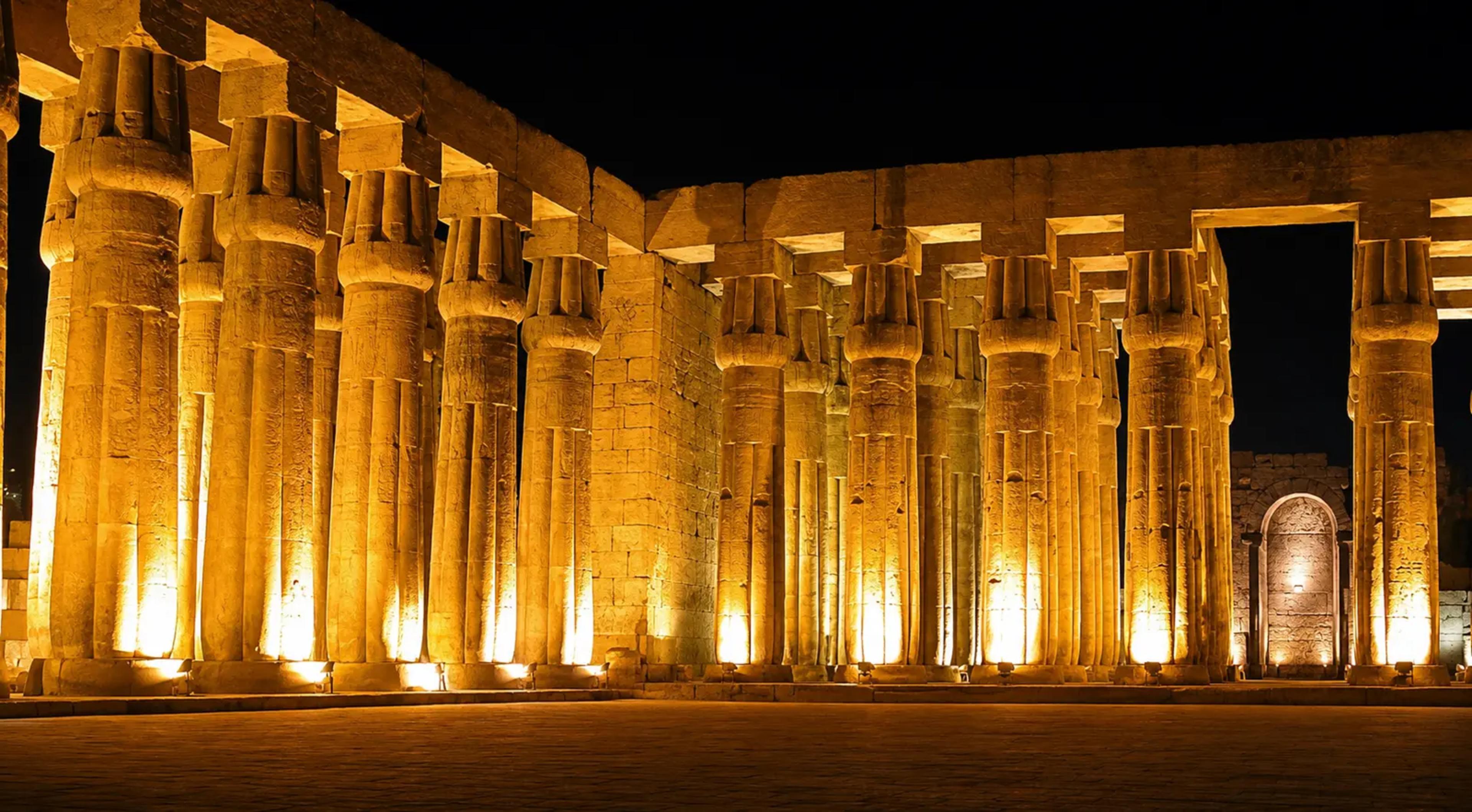
What it is
Luxor Temple stands on the east bank of the Nile in the centre of modern Luxor city — one of the few ancient monuments accessible on foot from most hotels. Unlike Karnak to the north, Luxor Temple was built primarily by two pharaohs — Amenhotep III (18th Dynasty) and Ramses II (19th Dynasty) — giving it an architectural coherence unusual among large Egyptian temples. The temple was dedicated to the annual Opet Festival, during which the statues of the Theban triad were carried in sacred barques from Karnak to Luxor and back, a journey of 3 km along the Avenue of Sphinxes. The site remained in continuous use: a Roman military camp was installed within the first court, a chapel was converted to a Christian church, and a mosque (Abu Haggag) still stands partly embedded in the structure's upper levels.
Why it matters historically
The Opet Festival — the most important religious festival of the New Kingdom; held annually during the Nile's inundation season; the procession renewed the divine kingship of the pharaoh; Luxor Temple was the destination, not the origin
Amenhotep III's colonnade — 14 papyrus-bud columns of the processional colonnade; the walls show the Opet Festival procession in extraordinary detail — musicians, priests carrying statues, crowds, the Nile barques; painted reliefs still show original pigment in the inner rooms
Ramses II's additions — the great pylon and the first court; the famous colossi and lone remaining obelisk (the twin is now in the Place de la Concorde, Paris); the battle of Kadesh reliefs on the pylon face
The Roman palimpsest — Roman soldiers converted the inner sanctuary into a shrine; the original Egyptian reliefs were plastered over and painted with Roman-era frescoes; some areas show both layers — the Egyptian relief visible where Roman plaster has fallen
Abu Haggag mosque — the medieval mosque built into the first court's upper level; the doorways of the mosque were installed at ground level, now suspended 10+ metres above the original floor after centuries of Nile silt built up the surrounding city
What to look for
The lone obelisk of Ramses II — 25 metres of red Aswan granite; the twin was given to France by Muhammad Ali in 1830. Look at the base reliefs: baboons worshipping the rising sun. Photo cue: morning, low angle, granite texture against blue sky.
Ramses II colossi — four seated and two standing statues framing the entrance; examine the cartouches (look for the Ramses II usurpation of earlier pharaohs' names on some figures). Photo cue: late afternoon western light directly on the granite faces.
The Opet Festival colonnade walls — entering from Ramses II's court into Amenhotep III's colonnade; east wall shows the procession going south (toward Luxor); west wall shows the return (boats going north to Karnak). Photo cue: any — the paintwork detail is remarkable in any light.
The Roman chapel — the innermost sanctuary; look carefully for the seam where Roman plaster meets Egyptian stone; the Egyptian reliefs of Amenhotep III visible underneath where the plaster has cracked. Often unremarked by standard tours.
Abu Haggag mosque — stand in the first court and look up to see the mosque entrance now hanging in mid-air; it was at street level when built; the accumulated Nile silt of centuries raised the city around the temple. Photo cue: wide shot upward showing mosque doorway against the pylon top.
The Avenue of Sphinxes connection — at the north (Karnak-facing) end; the sphinx heads here are human-headed (different from the ram-headed Karnak end); look south from Karnak for the full 3 km processional view.
Practical visiting block
Best time to visit: Late afternoon (15:30–17:30) for the western light raking across the colossi and pylon face; or evening (the temple is lit at night and the atmosphere changes completely). Morning is viable but the light comes from behind.
Tickets & fees:
Accessibility: The main access is level from street entry. The first and second courts are large and accessible. The inner colonnade is on the same level. No significant stairs for the main route. Restrooms at entrance.
Walking distance: Entrance to deepest sanctuary: approximately 300 metres. The full exploration with colonnade study: 500–700 metres total.
Restrooms: Available at entrance.
Tours that include this site
East Bank Day → /tours/east-bank-day — afternoon visit paired with morning Karnak
Two-Day Luxor → /tours/two-day-luxor — Day 1 afternoon; the dusk visit at the end of Day 1 is the design centrepiece
Related sites
Karnak Temple → /luxor/karnak — the northern terminus of the Avenue of Sphinxes; the procession originated here
Valley of the Kings → /luxor/valley-of-the-kings — Ramses II (who built the Luxor pylon) is buried across the river in KV7