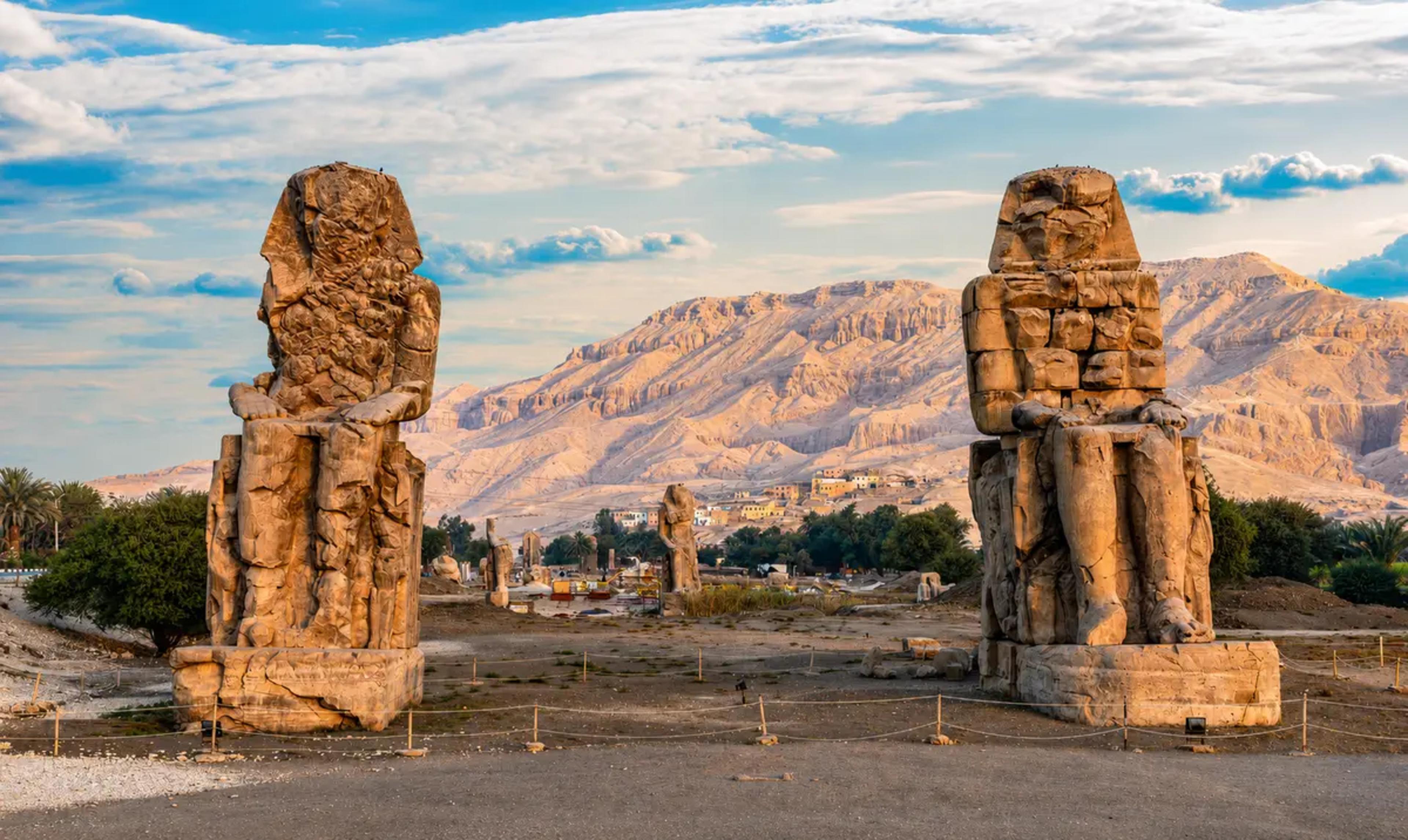
The Colossi of Memnon are the first thing most visitors see on the West Bank — two massive seated figures of Amenhotep III positioned beside the road before you reach the Valley of the Kings ticket office. They are so familiar from photographs that it is easy to pass them without stopping. That would be a mistake. These are among the largest surviving statues in Egypt, and the setting tells you something essential about the scale at which New Kingdom pharaohs conceived their relationship to the landscape.
What They Are
The colossi are the guardians of what was once the largest mortuary temple in Thebes — the memorial complex of Amenhotep III, who ruled Egypt from approximately 1388 to 1350 BCE in the Eighteenth Dynasty. The temple itself is largely gone, dissolved by centuries of Nile floods that covered and gradually destroyed the mudbrick portions of the structure. What remains above ground is the two quartzite statues and scattered column bases and wall fragments that are still being excavated.
Each colossus stands approximately eighteen metres tall — nearly sixty feet — and depicts the seated pharaoh wearing the double crown of Upper and Lower Egypt. At the sides of the thrones, smaller figures represent Amenhotep III's mother Mutemwia (left side) and his wife Tiye (right side). The statues were originally part of a processional entrance to the temple, flanking a gateway that is now gone.
Why They Were Famous in Antiquity
The northern colossus — the one on the left as you face them — was damaged, probably in an earthquake in 27 BCE, and thereafter was reported by ancient Greek and Roman travellers to emit a musical sound at dawn. The sound was caused by the rising temperature interacting with the cracked stone, producing a resonance that was interpreted as the voice of the mythological king Memnon (a son of Aurora, the goddess of dawn) greeting his mother each morning. The phenomenon attracted visitors from across the Mediterranean world, and the base of the statue is covered with Greek and Latin graffiti left by ancient tourists who had come specifically to hear the sound.
The Roman emperor Septimius Severus had the colossus repaired around 199 CE. The repairs ended the sound. The silence that has persisted for eighteen hundred years is itself a kind of historical record — evidence of a restoration that solved an engineering problem and eliminated an experience that had drawn visitors for two centuries.
What to Look For
Stand in front of the statues and look at the bases of the thrones. The carved reliefs on the sides show the union of Upper and Lower Egypt — the sema-tawy motif, in which the heraldic plants of the two kingdoms (the papyrus of Lower Egypt and the sedge or lotus of Upper Egypt) are tied together around the hieroglyphic sign for 'unite.' This is a standard element of royal throne decoration, but the scale here — each of the bound plants is larger than a human figure — makes it readable from a distance in a way that the same motif in a smaller context is not.
Look also at the erosion patterns on the faces. The northern colossus has been more heavily weathered and shows the effects of the ancient repair as a visible seam in the stone. The southern colossus retains more of its original surface, and the face, though damaged, gives a better sense of the refinement of the original carving. A quartzite this hard — harder than granite — required tools and techniques that Egyptian craftsmen had been perfecting for centuries.
The Ongoing Excavations
The Swiss-Egyptian Archaeological Mission, under the direction of Hourig Sourouzian since 1998, has been excavating the temple precinct behind the colossi and has recovered several major sculptures that were buried when the Nile floods destroyed the temple superstructure. Among the discoveries are sphinxes, seated figures of Sekhmet, and a partial reconstruction of the second pylon. The work is ongoing and the site is partially accessible to visitors. The colossi are not a terminal point; they are the entrance to a much larger and still-active archaeological site.
Practical Visiting Notes
The Colossi are visible from the road and there is no entrance fee for viewing them from the access area immediately in front of the statues. Photography is permitted without restriction. The site is in direct sun with no shade; visit in the early morning or late afternoon. The statues are on the main road from the Luxor-West Bank ferry to the Valley of the Kings, so they can be combined with any West Bank day tour without additional travel time.
Tours that include this site: the West Bank Day tour stops here as an included site; the Two-Day Luxor itinerary includes it on the West Bank morning. I sometimes stop here specifically at the end of an afternoon when the light is striking the western face of the southern colossus at low angle — the carved reliefs on the throne sides catch the late sun in a way that is not visible at any other time of day.