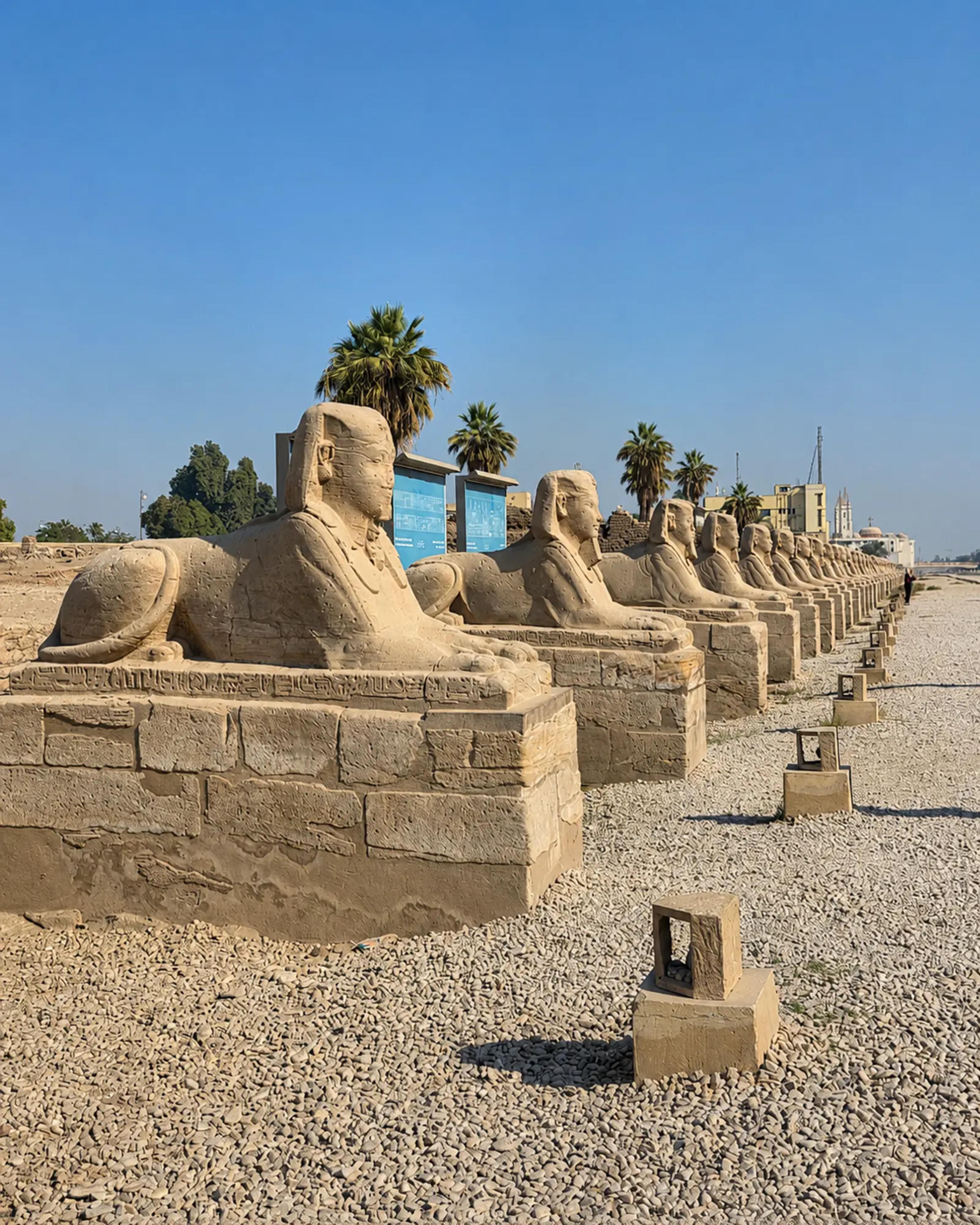
The Avenue of Sphinxes — known in Arabic as the Tareeq el-Kebash — was one of the great ceremonial processional routes of ancient Thebes. It connected the Luxor Temple on the East Bank, across what was then open floodplain, to the Karnak Temple complex approximately three kilometres to the north. The avenue was lined with ram-headed sphinxes (criosphinxes) placed there by successive pharaohs over a period of centuries. In November 2021, after a decade of excavation and restoration, the Egyptian Ministry of Tourism and Antiquities reopened the avenue to the public.
A Road Built Over Three Thousand Years
The avenue was not built in a single campaign. The earliest sphinxes are from the reign of Amenhotep III in the Eighteenth Dynasty, around 1380 BCE. Nectanebo I added more sphinxes in the Thirtieth Dynasty (around 380 BCE), almost a thousand years later. The distance between the two temples — approximately 2,700 metres — was maintained as a ritual pathway even as the city around it was built, demolished, and rebuilt over the succeeding centuries.
The processional route was the path of the Opet Festival, one of the most important festivals in the New Kingdom Egyptian calendar. During the Opet Festival (held during the second month of the inundation season, typically August-September), the cult statue of Amun was carried from Karnak to Luxor Temple in a ceremonial barque, accompanied by the pharaoh and the priests. The journey symbolised the union of Amun with his southern sanctuary and the renewal of the pharaoh's divine authority. The sphinxes were not decorative; they were guardians of the sacred way.
The Excavation and Restoration
The modern city of Luxor had been built over much of the avenue's length. Excavation required demolishing houses and relocating residents — a process that spanned multiple phases of work beginning in the 1950s under Zahi Hawass and accelerating dramatically in the 2010s. The Egyptian Ministry of Antiquities has been transparent that the excavation was difficult and socially complex, involving negotiations with property owners and the relocation of families whose homes had stood on the route for generations.
The restored avenue now features the original criosphinxes where they were found, supplemented with replicas where the originals were too damaged for display. The path is paved with stone and illuminated for evening visits. At the Luxor Temple end, the avenue connects to the southern entrance of the temple complex; at the Karnak end, it enters through the southern gate near the Khonsu Temple.
What to Look For
The individual criosphinxes are worth looking at closely. Each sphinx is a lion body with a ram head — the ram being sacred to Amun — and between the forepaws is a small standing figure of the pharaoh, protected by the divine embrace. The stylistic variations between sphinxes from different periods are visible if you look for them: the Eighteenth Dynasty examples tend toward a more naturalistic treatment of the face; the Thirtieth Dynasty additions have a slightly more frontal quality consistent with the Late Period sculptural conventions.
Walk the avenue from Luxor Temple toward Karnak in the late afternoon, when the light is coming from the west and the shadows between the sphinx bases are long. The scale of the original conception — three kilometres of guarded processional way through what was one of the great cities of the ancient world — becomes palpable when you are walking it rather than photographing it.
Practical Visiting Notes
The Avenue of Sphinxes is accessible from both the Luxor Temple entrance and the Karnak south gate. No separate ticket is required for the avenue itself; access is included with the Luxor Temple or Karnak Temple tickets. The avenue is lit at night and is a pleasant evening walk. Walking the full length in both directions takes approximately one hour at a slow pace.
Tours that include this site: the East Bank Day tour begins at Karnak Temple and ends at Luxor Temple; the avenue can be walked between them as a connecting route on foot (approximately 45 minutes one way) or by carriage. I recommend the walk for clients who want to understand the spatial relationship between the two temples — the avenue makes this relationship physical and immediate in a way that a vehicle transfer does not.