Why Hatshepsut's name was erased
Why did Thutmose III erase Hatshepsut? A close reading of the evidence from Karnak and Deir el-Bahari.

Egyptologist Tour Guide, Luxor
Published: · Last updated · 11 min read
What the erasure looks like
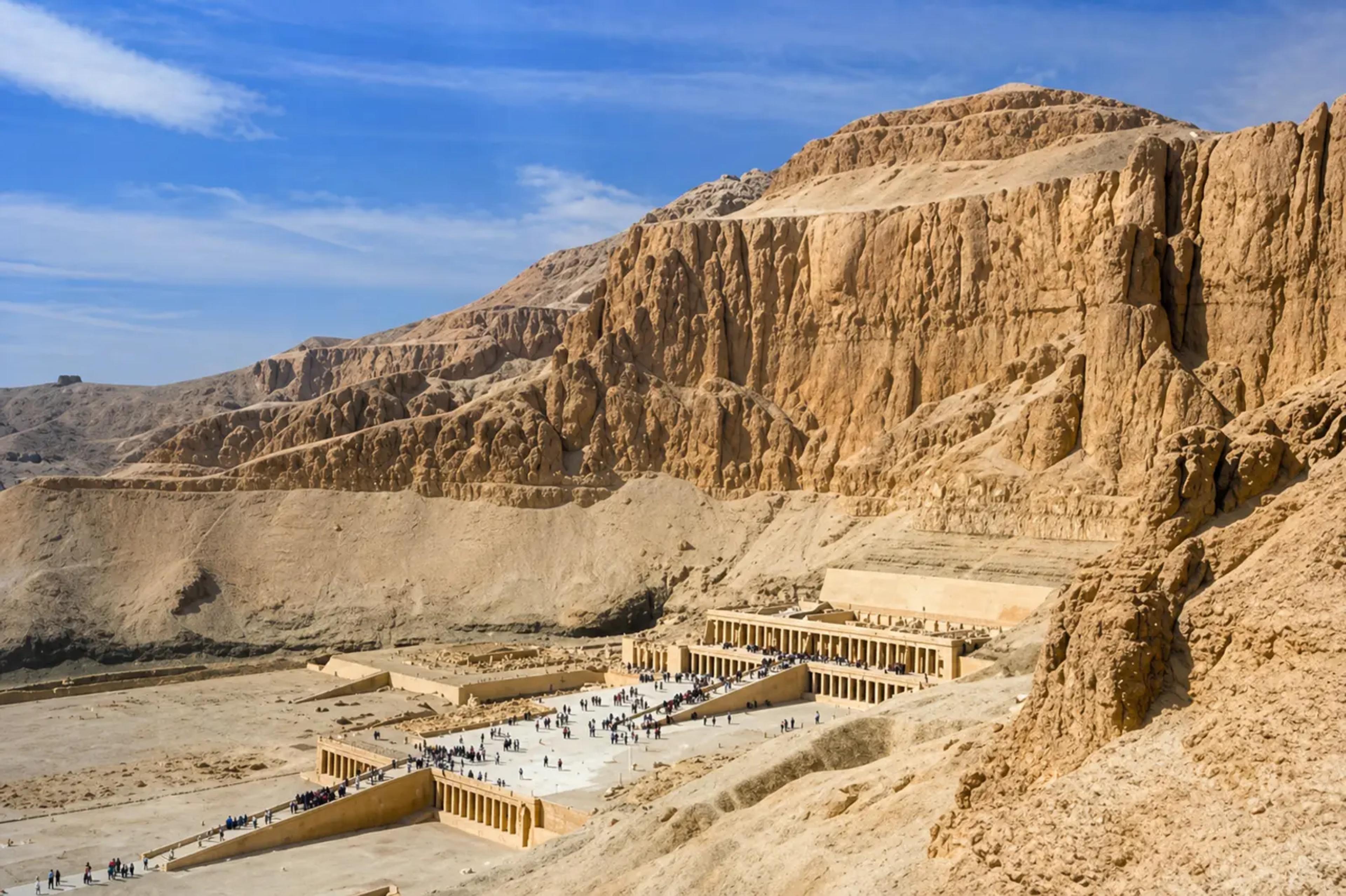
The physical evidence at Deir el-Bahri: rectangular carved voids in the middle terrace colonnade; smooth recesses where cartouches containing Hatshepsut's name were chiselled out; the surrounding relief left intact
At Karnak: Hatshepsut's images replaced or covered; the wall behind her obelisks at Karnak walled in by Thutmose III — crucially, the obelisks themselves were not destroyed
The pattern of erasure: selective, not total; the upper surfaces of obelisks and the high-register images that required significant scaffolding to reach were often left intact; the erasure was executed at accessible heights
The dating problem: the erasure was not carried out during Hatshepsut's lifetime (she died still ruling); it occurred after her death; the timing within Thutmose III's subsequent sole reign is debated — possibly Year 42–45 of his reign, approximately 20 years after her death
Who was Hatshepsut?
18th Dynasty pharaoh; daughter of Thutmose I; married to Thutmose II; became regent for the child Thutmose III on Thutmose II's death; declared herself pharaoh and ruled as co-regent for approximately 20 years (c. 1479–1458 BC)
Adopted the full male pharaonic iconography: double crown, false beard, the crook and flail; her statuary shifts between female and male forms depending on context; inscriptions use both masculine and feminine grammatical forms within the same texts
Major building programmes at Karnak (four obelisks, the Red Chapel, expansion of the sanctuary) and at Deir el-Bahri (the mortuary temple); the Punt expedition; trade and commerce rather than military campaigns characterise her reign
The Getty-assisted reidentification (2006): her mummy, previously unidentified in KV60, was confirmed through a molar in a canopic box bearing her cartouche; this is one of the most consequential identifications in modern Egyptology
Why Thutmose III — and the debate about motivation
The traditional narrative (pre-1990s): Thutmose III resented Hatshepsut's usurpation of his throne and enacted revenge posthumously; the erasure as misogynist retaliation; this reading dominated popular understanding through most of the 20th century
The revisionist position (post-excavation evidence): the timing — approximately 20 years after her death — makes personal resentment an unlikely sole motive; if Thutmose III wanted revenge he had two decades of sole rule in which to do it
The succession argument (current scholarly consensus): the erasure was a dynastic legitimacy move; Thutmose III was preparing the succession of Amenhotep II; removing Hatshepsut from the visible record restructured the dynastic narrative to pass directly from Thutmose I → Thutmose II → Thutmose III → Amenhotep II, erasing the anomaly of a female pharaoh from the official succession line
The incompleteness problem: if the goal was obliteration, it failed; enough survived to reconstruct her reign in detail; the walling-in of the obelisks rather than their destruction suggests preservation alongside concealment — or simply a pragmatic decision not to waste large stone structures
What the evidence cannot tell us: whether Thutmose III ordered the erasure himself or whether it was ordered by someone in his court; whether Hatshepsut cooperated in her own suppression during the last years of her rule as her health declined
What survived — and why
The Punt expedition reliefs: substantially intact; possibly because the lower register of the middle terrace colonnade was less politically salient than the upper pylon inscriptions
The tomb (KV20): the original tomb was shared with Thutmose I; the burial goods and canopic equipment survived in KV60; the tomb itself was not destroyed
The statuary at Deir el-Bahri: the famous Hatshepsut sphinx fragments and the colossal heads were found smashed and buried in a pit at the site; this has been read as deliberate destruction, but the burial — rather than dispersal — may indicate a more ambivalent relationship to the material
The textual record: the Punt expedition, the obelisk inscriptions, the Red Chapel at Karnak — all carry enough surviving text to reconstruct her theological programme in detail
The irony of the erasure: Hatshepsut is now one of the most studied and most recognisable pharaohs of the New Kingdom precisely because the erasure drew scholarly attention to her; the attempt to remove her from the record preserved her in historical consciousness
How to see the evidence at Deir el-Bahri
The middle terrace north colonnade: the erasure rectangles are at eye height; the oblique light that makes them readable is best in the morning when the sun is still low; a torch (flashlight) makes the voids more legible
Comparing intact vs. erased sections: the south colonnade of the same terrace retains more; standing at the junction between the two sections and looking down the length of the colonnade gives direct visual access to the scale of the project
The Karnak connection: the walled obelisks at Karnak (the taller one is still visible above the wall Thutmose III built around it) are the most direct physical evidence of the ambivalence in the erasure campaign; visible from the ground; I point this out specifically on the East Bank Day
Luxor Museum: fragments of the smashed Hatshepsut statuary are displayed with scholarly context; the museum exhibit is one of the best secondary sources for this story in Luxor; I include it when I have a guest specifically interested in this question
The afterlife of the story
How Egyptologists reconstructed Hatshepsut's reign from the erased record: the detective work of the 19th and 20th centuries; Herbert Winlock's excavations at Deir el-Bahri; the identification and naming of KV60
The popular culture legacy: Hatshepsut's story has been retold as feminist history, as political drama, as archaeological mystery; each retelling reflects its moment more than it reflects the 18th Dynasty
What I tell guests who ask about Thutmose III: "He built more at Karnak than any other pharaoh. He ran sixteen military campaigns. He was one of the great organisers of the New Kingdom. The erasure is one part of his story, and not the most consequential one."
The question the evidence leaves open: what Hatshepsut knew about her own legacy; whether the concealment during her lifetime of certain documents and titles was her own political hedging; the agency question that scholarship has not resolved
Related
Tour cross-link: Specialist Day → /tours/specialist-day — the tour that includes time at Deir el-Bahri with the erasure context as a structured focus
Encyclopedia cross-link: Hatshepsut Temple → /luxor/hatshepsut-temple — the full site guide including the physical erasure evidence
Encyclopedia cross-link: Karnak Temple → /luxor/karnak — the walled obelisks and the Karnak-side erasure evidence
About cross-link: /about