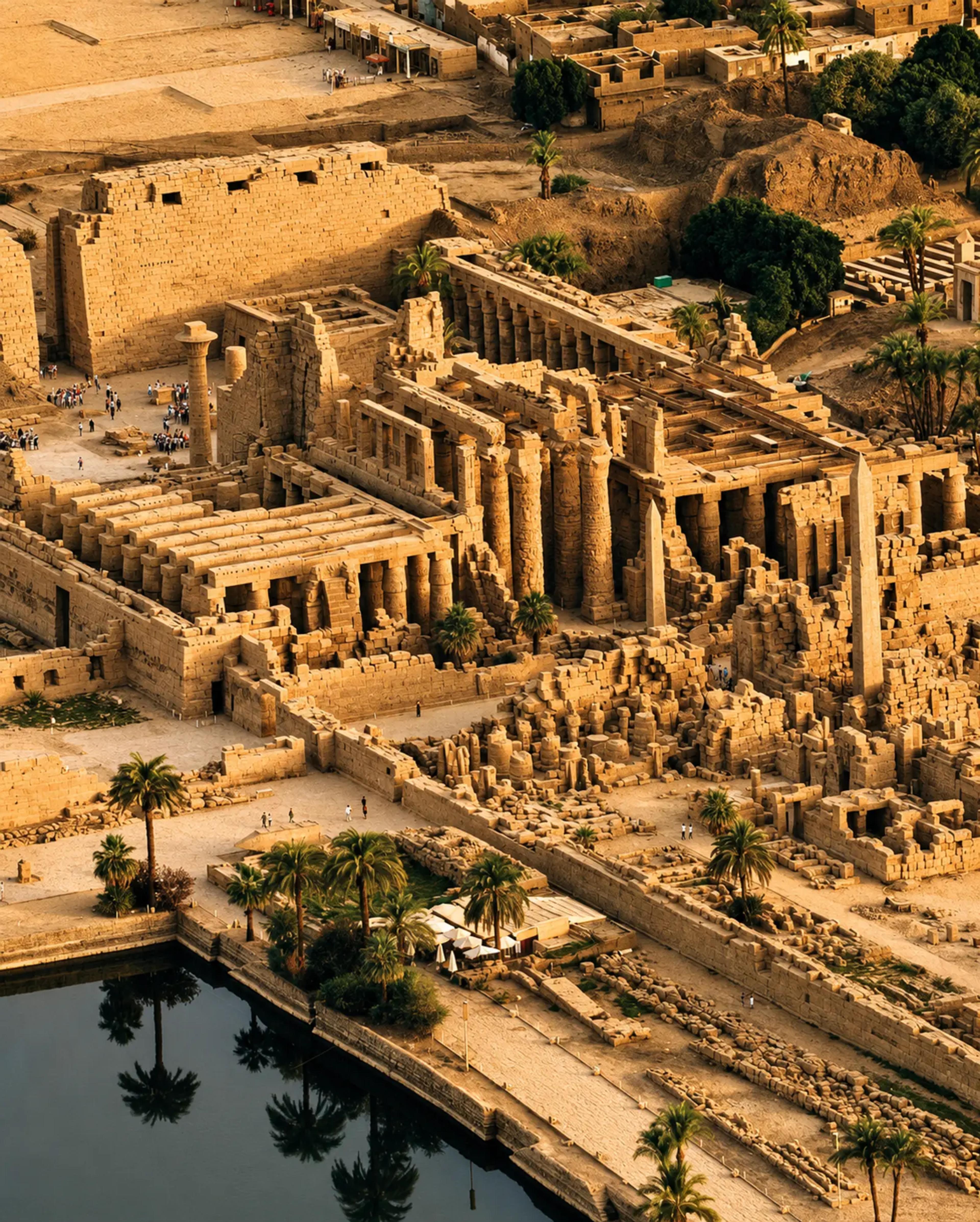
The Best Time to Visit Karnak Temple (And Why the Answer Isn't What Tour Operators Tell You)
When is the best time to visit Karnak Temple? The answer depends on what you want to see — and it is not the same as what tour operators typically recommend.

Egyptologist Tour Guide, Luxor
Published: · Last updated
Every tour operator in Luxor will tell you to visit Karnak Temple between 8 and 11 a.m. This is correct advice in the sense that it avoids the midday heat. It is wrong advice in almost every other respect. The 8 to 11 window is when five hundred other tourists are also following the advice of their tour operators. It is when the sound and light show crowds from the previous night are still circulating. It is when the coaches fill the enormous car park outside the Triumphal Gate and the guided groups move through the Hypostyle Hall in a stream that makes independent looking almost impossible.
I have been guiding Karnak for seventeen years. I am there before most days begin. I have seen it in every season, every weather condition, and at every hour from 4:30 a.m. to after midnight for the sound and light show. Here is what I actually know about the best time to visit — which varies significantly depending on what you want from the experience.
Dawn: The Answer For Most Visitors
The best single time to visit Karnak Temple, for most purposes, is at opening time — currently 6 a.m. in summer and 6:30 a.m. in winter. In the first ninety minutes after opening, before the large tour groups arrive, it is possible to walk through the Hypostyle Hall in a state of relative quiet. This matters more than it sounds.
The Hypostyle Hall at Karnak contains 134 columns, the largest of which are 21 metres tall. The hall covers 5,000 square metres. When it is full of tour groups, the acoustic effect is disorienting — hundreds of guides speaking simultaneously in eight languages, the sound bouncing off the columns and the remaining ceiling sections. When it is nearly empty, which is what you get at 6 a.m., the hall is one of the most extraordinary spaces in Egypt. You can hear your own footsteps. You can see the shadows changing on the column faces as the sun rises above the entrance pylon. You can look straight up at the hypaethral ceiling openings and watch the sky lighten.
The light at dawn is also the most useful light for reading the carvings. The angle of the early morning sun casts the reliefs into sharp relief — literally: the shallow-cut scenes that are invisible in flat midday light become readable as the low-angle illumination picks up the tool marks and the depth of the cutting. This is how these surfaces were designed to be seen. The ancient Egyptians built their ritual lives around the direction and quality of light at specific times of day. The Hypostyle Hall is oriented east-west; the morning light enters through the entrance pylons and travels down the central axis of the hall in a way that was planned, not accidental.
Late Afternoon: The Answer For Photographers and Return Visitors
The second-best time to visit Karnak is late afternoon, from about 3 p.m. to closing time (5 p.m. in winter, 6 p.m. in summer depending on the season). By mid-afternoon the large coach groups have left — they operate on morning schedules and are back at their hotels by 1 or 2 p.m. The temple is quieter than it will be at any other point during the day except early morning. The light is golden and low-angled, which is the best photographic light for stone surfaces.
The disadvantage of late afternoon is temperature in summer — from May to September, 4 p.m. in Luxor is still 38 to 40 degrees. Carry significant water. The advantage is that the lighting of the sacred lake and the surrounding palm trees in late afternoon is exceptional, and the walk from the lake back through the smaller rear halls (the Festival Temple of Thutmose III, the chapels of the Hearing Ear behind the main sanctuary) is less congested than at any other time of day.
The Sound and Light Show: Worth It Or Not
The Karnak Sound and Light Show is a long-running night spectacle that takes visitors through parts of the temple complex by night, with narration, coloured lighting, and recorded music. I am asked about it regularly. My honest answer: it depends on what you have already seen.
If you have not visited Karnak during the day, the Sound and Light Show is not a substitute. The narration is melodramatic and occasionally inaccurate in ways that will bother anyone with historical knowledge of the site. The coloured lighting is atmospheric but obscures the detail of the carvings rather than revealing it. The route does not include the Hypostyle Hall itself (which would be impossible to navigate safely with a large night crowd) and instead takes visitors around the sacred lake and through the outer courts.
That said: the sacred lake at Karnak at night, with the reflections of the floodlit first pylon on the water and the sound of the performance echoing across the complex, is genuinely striking. If you have already visited during the day and want to see the site in a completely different light — literally — it is worth attending once. Go for the atmosphere, not the education.
Season: What Actually Matters
The tour operator answer to 'when to visit Luxor' is almost always October-to-April, avoiding the summer heat. This is not wrong for general comfort, but it obscures something important: what is lost in each season.
October and November are excellent months. The summer heat is ending, the Nile flood has receded, the light is clear and direct. The tour groups from Europe and the US are arriving in volume, which means the 8-to-11 window at Karnak is genuinely crowded. Early morning visits are more necessary, not less, in the peak season.
June, July, and August — the months that operators consistently recommend against — are the months when Karnak is least crowded by foreign tourists. Egyptian domestic tourism continues, but the large international groups are absent. If you can tolerate the heat (carry three litres of water, start at 6 a.m., be back inside by 10 a.m.), summer is when you can have the Hypostyle Hall almost to yourself. I have walked through it on July mornings with fewer than a dozen other people visible. That is not an experience available in February.
What to Actually Do Inside
Most visitors to Karnak spend ninety percent of their time in the Hypostyle Hall and the main processional axis between the first and sixth pylons. This is where the drama is — the enormous columns, the surviving polychrome decoration, the views of the obelisks. But Karnak is much larger than that area.
The Festival Temple of Thutmose III, in the rear of the complex east of the main sanctuary, contains some of the strangest and most interesting decoration at Karnak: the 'Botanical Garden' room, where the walls are carved with images of plants and animals brought back from military campaigns in Canaan and Nubia — a natural history record from 1450 BCE. It is rarely crowded and is included in the standard entrance ticket.
The Open Air Museum, just inside the entrance on the left, contains reconstructed Middle Kingdom shrines — including the White Chapel of Senusret I, a small alabaster structure from around 1900 BCE that is one of the most refined pieces of architecture surviving from the Middle Kingdom. It is almost always empty of visitors and almost never mentioned in the standard tour circuit.
Karnak is a site where a three-hour visit barely begins to cover what is there. Plan accordingly. Come early, carry water, and save the Hypostyle Hall for last — when you have seen the wider complex and can approach the columns with some context for the two thousand years of building history they stand within.